


The Catalyst: Dissecting the News
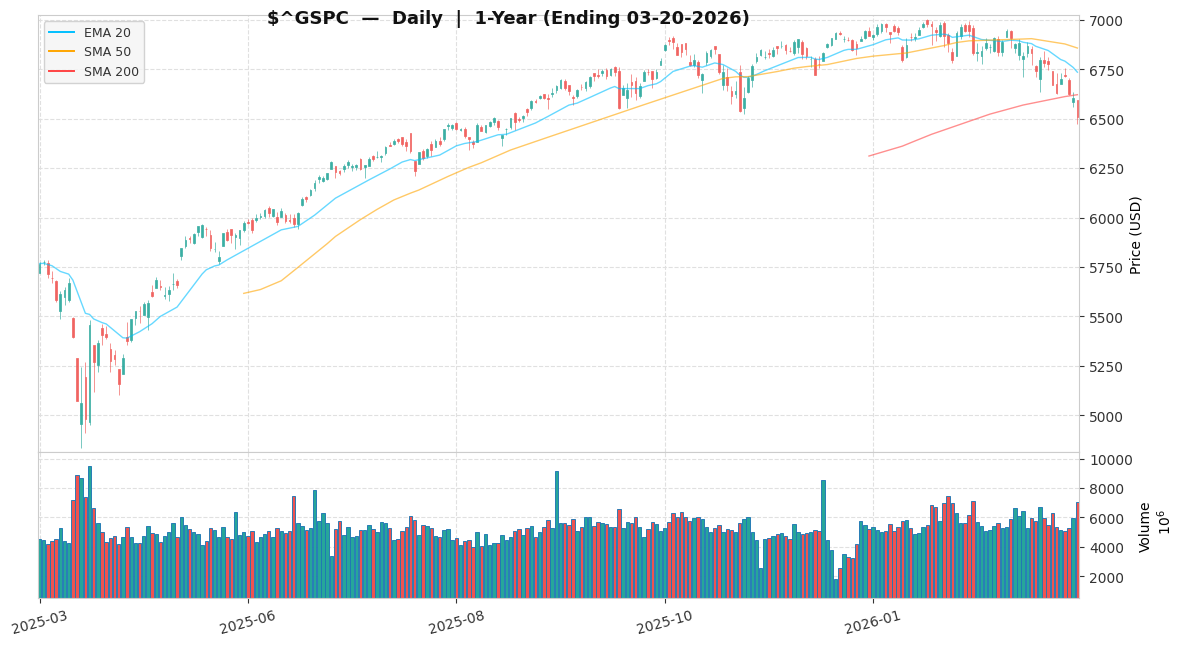
The primary catalyst for a re-evaluation of the broad market outlook is the deteriorating U.S. labor market, evidenced by a substantial increase in job cuts with over 108,000 announced in January and a net reduction of 97,000 non-farm payroll jobs in February, signaling a less optimistic outlook for 2026. This moderate pullback of approximately 5.7% from the 52-week high reflects growing concerns over economic stability and corporate earnings, suggesting a period of measured caution for broad market indices.
Core Logic & Growth Drivers
The S&P 500 ($SPY) broadly reflects the aggregate earnings power of its 500 constituent companies, with Street expectations currently recalibrating for a more moderated growth trajectory in 2026. The market’s underlying monetization vector, corporate profitability, remains subject to external macroeconomic forces, with recent data points suggesting a deceleration in aggregate earnings growth, particularly as inflation persists and consumer demand shows signs of fatigue. Aggregate capital expenditures and research & development investments across S&P 500 companies are expected to face scrutiny, with corporate free cash flow profiles becoming increasingly critical in a higher-rate environment, per S&P 500 aggregate / Federal Reserve. The S&P 500 faces significant industry headwinds from persistent geopolitical tensions, elevated energy prices, and the structural implications of technological shifts like AI, which collectively present a complex challenge to corporate profitability. My thesis would be materially impaired if non-farm payrolls continue to show net job losses for two consecutive months, or if the unemployment rate rises above 4.5% for two consecutive months, signaling a more profound economic contraction.
The Financial Reality
The U.S. non-farm payrolls saw a reduction of 97,000 jobs in February, significantly below the consensus expectation of adding 55,000 jobs, with the unemployment rate ticking up to 4.4% from 4.3% in the prior month. The Federal Reserve has maintained a cautious stance on interest rates amidst persistent inflation, with market participants closely monitoring future data for signs that could prompt a shift in policy direction towards rate adjustments. Historically, significant and unexpected job market contractions have been associated with heightened volatility in equity markets and a flight to safety in bond markets, reflecting increased investor risk aversion. At approximately 20x forward earnings, the S&P 500 sits in the upper range of its historical 10-year band (~14x–22x), implying limited cushion against multiple compression if earnings disappoint — the equity risk premium relative to real rates remains compressed, leaving the index vulnerable to sentiment-driven re-pricing. The upcoming monthly jobs report and inflation data releases will be critical in shaping the near-term macro narrative, offering further clarity on the trajectory of the U.S. economy and potential implications for monetary policy.
Actionable Strategy
I’m assigning the S&P 500 (SPY) — Broad Market Outlook ($SPY) a ‘Hold’ rating for the next 12-18 months, reflecting my cautious stance amidst prevailing macroeconomic uncertainties. This position serves as a core index-tracking allocation, where tactical entry on market dislocation is prudent, rather than aggressive accumulation at current levels. With roughly equal (~33%) probability weighting across scenarios, the probability-weighted expected return is approximately ~3.7% (= (+8.0% + 15.0% − 12.0%) ÷ 3), reflecting a positive expected return under equal-weight scenario assumptions, though targets are scenario-based, not fundamentally anchored. My Base Case target is $710.64, representing a +8.0% upside scenario from the current market price of $658.00 as of 2026-03-21. As a broad market index, targets are scenario-based rather than derived from fundamental multiples of a single entity. My Bull Case target is $756.70, representing a +15.0% upside scenario from current levels, which I believe could materialize if inflation moderates more swiftly than anticipated and corporate earnings demonstrate unexpected resilience. My Bear Case target is $579.04, representing a -12.0% scenario-based decline if non-farm payrolls continue to show net job losses for two consecutive months, or if the unemployment rate rises above 4.5% for two consecutive months, at which point I would advise against initiating any new position. The key operational KPIs I will monitor each quarter to track this thesis: non-farm payroll figures, the unemployment rate, and the Consumer Price Index (CPI) readings, each of which I expect to show stabilization or improvement before considering any position expansion. With a PWR of ~3.7% under equal-weight scenario assumptions, the risk-adjusted case for broad equity exposure weakens relative to current ~4.3% short-term Treasury yields — suggesting tactical patience rather than aggressive allocation at this level. Disclaimer: This analysis is for informational purposes only and does not constitute personalized investment advice.