


The Catalyst: Dissecting the News
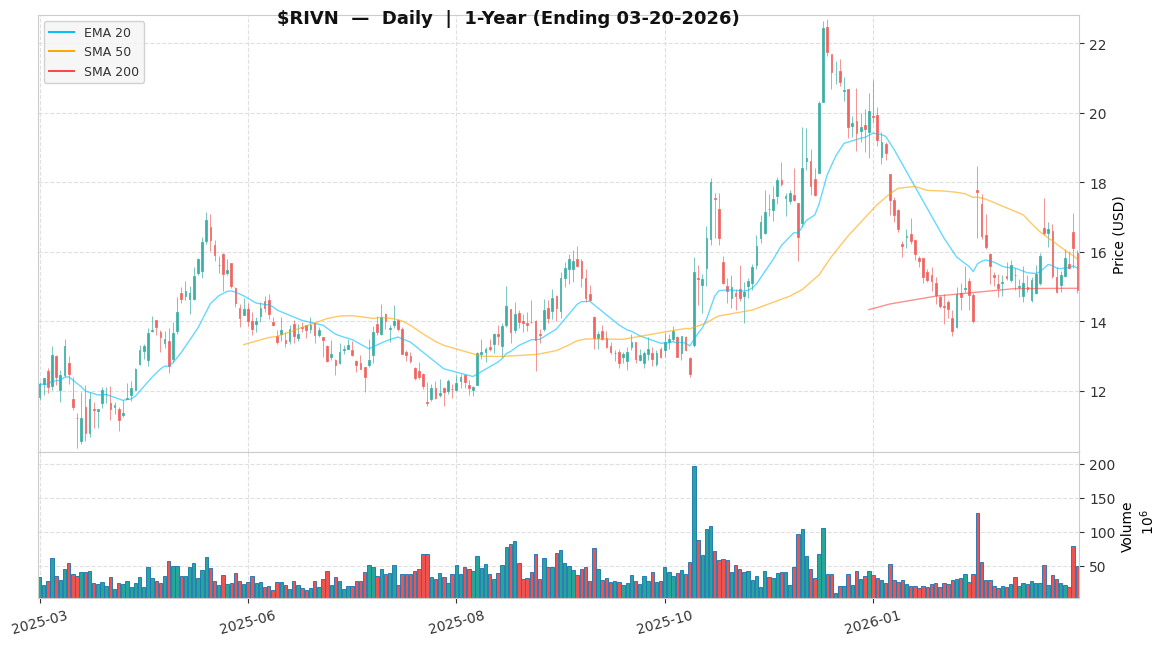
The primary catalyst for the recent re-rating of Rivian Automotive, Inc. ($RIVN) stems from heightened geopolitical tensions surrounding Iran, which analysts anticipate will exert upward pressure on global oil prices. While geopolitical spikes can be transient, I’m assuming this risk premium remains structurally elevated over the 12-18 month horizon, shifting consumer and fleet purchasing calculus in favor of EVs as fossil fuel cost certainty erodes. The stock’s approximately -34.2% drawdown from its 52-week high reflects a broader valuation reset for high-growth, pre-profitability entities within the automotive sector, now potentially offering a more compelling entry point for patient capital seeking exposure to the electrification trend.
Core Logic & Growth Drivers
The core growth thesis for Rivian Automotive, Inc. ($RIVN) is predicated on its ability to scale production and delivery of its R1T pickup, R1S SUV, and commercial vans, aligning with Street expectations for increasing EV adoption. Rivian Automotive, Inc.’s EV production has emerged as a meaningful but volatile revenue driver; its contribution remains market-dependent and subject to supply chain dynamics, making quarter-to-quarter visibility limited. Significant ongoing capital expenditures and research & development investments are inherent to its growth trajectory, funded by its substantial cash reserves, though current operations reflect negative free cash flow typical of a scaling enterprise. The competitive landscape remains intense, with established players like Tesla continuing to dominate the premium EV segment and legacy automakers such as Ford and General Motors rapidly expanding their own electric vehicle offerings, creating sustained pressure on market share and pricing. Beyond competitive dynamics, I flag three non-financial risks that could materially alter this thesis: (1) production ramp execution risk — delays or quality issues at scale could compress the revenue trajectory; (2) EV subsidy and regulatory policy risk — any reversal in federal EV incentives would dampen demand acceleration; and (3) dilution risk — given the pre-profitability stage, I assume at least one additional capital raise within the investment horizon, which could partially offset upside via share count expansion. The bear case would be triggered if quarterly cash burn exceeds $194.8M for two consecutive quarters, signaling a deterioration in capital efficiency and operational control.
The Financial Reality
Rivian Automotive, Inc. ($RIVN) is priced at $14.91 as of recent trading, significantly below its 52-week high of $22.69 but above its 52-week low of $10.36. The Forward P/E of -7.74x reflects Rivian Automotive, Inc.’s pre-profitability status, typical for early-stage companies in this sector, and is not a meaningful standalone valuation signal. Rivian Automotive, Inc. holds approximately $6082.0M in cash, burning ~$194.8M per quarter, implying approximately 31.2 quarters of runway before additional capital is required — a critical metric for long-term operational viability. Despite this extended runway, I assume proactive equity issuance is likely well before exhaustion: management at scaling EV companies typically accesses capital markets from a position of strength rather than necessity, making dilution a realistic near-term consideration even with current liquidity adequate. The company’s Debt/Equity ratio of 113.08% indicates elevated but serviceable financial leverage, a common characteristic for growth-oriented manufacturing firms in their scaling phase.
Actionable Strategy
I’m rating Rivian Automotive, Inc. ($RIVN) a ‘Speculative Buy’ over a 12-18 month horizon. I view this position as a speculative growth play sized for its pre-profitability risk profile within a diversified portfolio, rather than a core allocation. With roughly equal (~33%) probability weighting across scenarios, the probability-weighted expected return is approximately ~48.7% (= (+49.0% + 121.9% − 24.9%) ÷ 3), proving the asymmetric upside skew. My Base Case target is $22.21, derived from a 5.1x P/S (Price-to-Sales) multiple on Revenue per Share (TTM) of $4.3546 per trailing twelve-month revenue data as of 2026-03-21, representing a +49.0% move from current levels. The 2.57x–7.6x scenario range broadly reflects the Bear-to-Bull P/S band observed across early-stage EV OEMs at comparable revenue scales — the base 5.1x sits near the sector median for companies demonstrating early signs of gross margin recovery. The current -7.74x forward P/E reflects persistent operational losses and investor skepticism regarding the path to profitability, which has compressed its valuation relative to its long-term potential; a sustained improvement in gross margins and demonstrable progress towards positive free cash flow, alongside favorable macro tailwinds for EVs, would resolve this overhang, justifying a re-rating toward the 5.1x base target. My Bull Case target is $33.09, applying 7.6x to the same Revenue per Share (TTM), suggesting a +121.9% move from current levels, achievable if geopolitical tensions persistently elevate fossil fuel prices, accelerating EV adoption and solidifying Rivian Automotive, Inc.’s market position. The 7.6x multiple reflects the re-rating potential achievable if Rivian demonstrates sustained gross margin inflection and revenue acceleration, consistent with EV peers at comparable early-growth stages. My Bear Case target is $11.19, applying a compressed 2.57x multiple, indicating a -24.9% downside from the current price if quarterly cash burn exceeds $194.8M for two consecutive quarters, at which point I would re-evaluate the position for a potential reduction. The 2.57x multiple reflects distressed EV sector valuations in a scenario of persistent cash burn and deteriorating investor confidence in the path to profitability. The key operational KPIs I will monitor each quarter to track this thesis: quarterly delivery volumes, gross margin trajectory, and cash burn rate — each of which I expect to show improvement before considering any position expansion. Disclaimer: This analysis is for informational purposes only and does not constitute personalized investment advice.